Quick answer: The Model Context Protocol (MCP) lets an AI agent inside your IDE call your own tools directly, with no IDE-specific plugin. You keep your Rust CLI as the engine, wrap it in a small TypeScript MCP server that declares its capabilities, and any MCP-compatible host (Claude Code, Cursor, Windsurf) can then run real actions on your codebase instead of just suggesting them.
The Model Context Protocol (MCP) allows you to expose internal tools to an AI agent directly in your IDE, without IDE-specific plugins, without ad hoc integrations. Instead of giving suggestions, the agent can execute real actions on your codebase.
The problem MCP solves
AI agents embedded in IDEs are great at understanding context: analyzing code, explaining errors, suggesting refactors. But when it comes to executing real actions (running internal scripts, triggering business logic, validating outputs against proprietary rules), a friction loop appears: the agent proposes → you run it elsewhere → you paste the output back in. Every time.
MCP closes this gap by providing a standard to expose capabilities (CLIs, APIs, internal services) via a structured contract that any compatible IDE or AI assistant can directly consume.
MCP vs REST: not just another API
The difference isn’t in the message format, it’s in the integration model:
- REST exposes endpoints. The orchestration is written client-side, the client is known in advance, nothing standardizes usage by an agent.
- MCP exposes declared capabilities (
tools,resources,prompts). The host discovers them dynamically, the agent decides how to chain them, responses are structured to be interpretable and re-plannable.
REST exposes services. MCP exposes actions exploitable by agents.
Architecture: motor / façade / cockpit
In our implementation at Ippon:
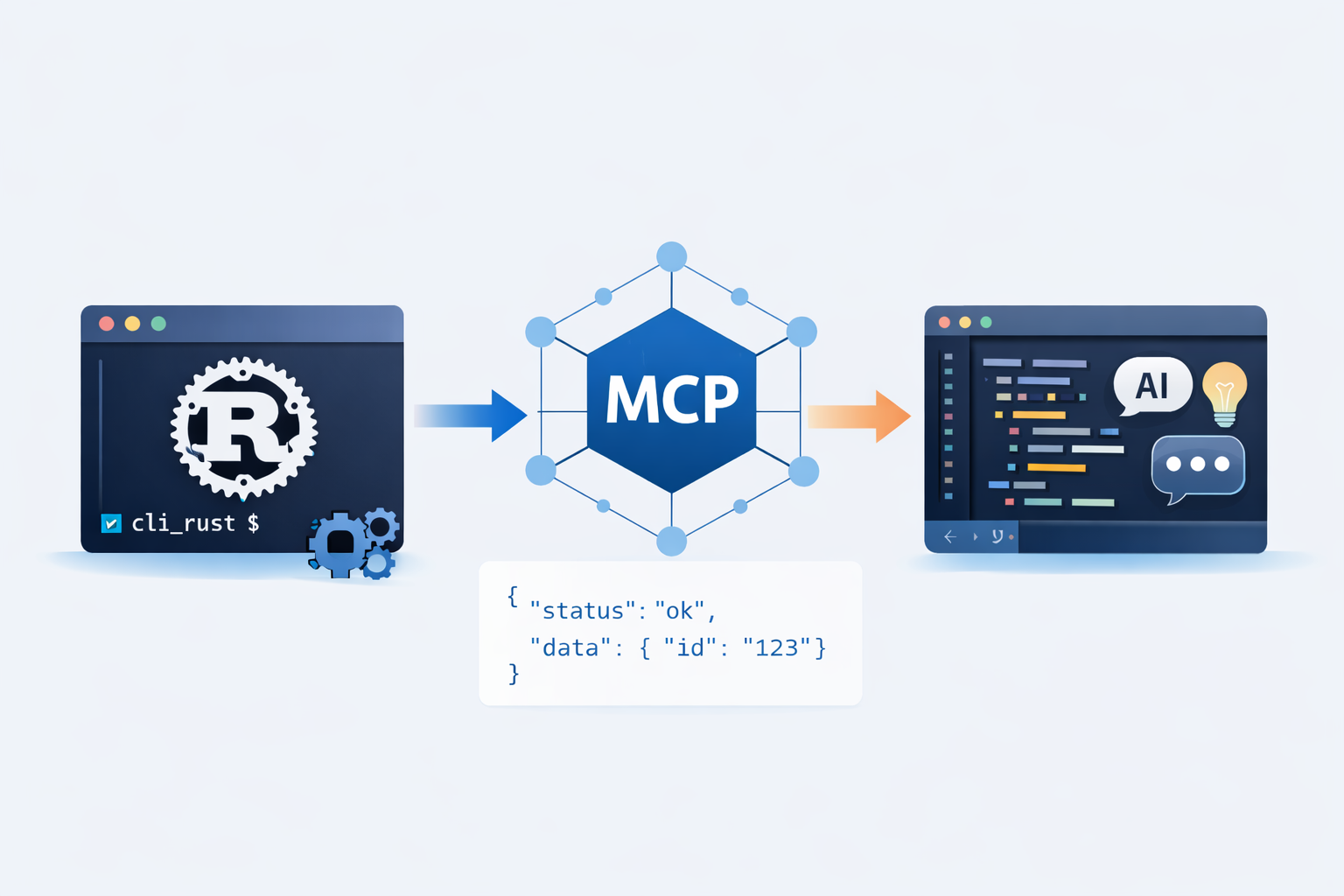
- Rust CLI = the motor: business logic, performance, source of truth. Nothing changes here.
- TypeScript MCP server = the façade: the contract, parameter validation, capability exposure via the MCP SDK.
- IDE/agent = the cockpit: orchestration and UX.
A single integration target replaces N IDE-specific plugins. Exposing a tool is surprisingly concise:
server.tool("analyze_module", {
  inputSchema: { type: "object", properties: { module: { type: "string" } }, required: ["module"] }
}, async ({ module }) => {
  const result = await runCli(["analyze", module]);
  return JSON.parse(result);
});
Why not a VSCode plugin?
The “smart plugin” approach hits structural problems fast: the N-IDE effect (every host is a new target), duplicated business logic that drifts from the CLI, fragile stdout parsing that turns logs into an implicit API, and IDE lock-in. MCP inverts the posture: start from the capabilities, not the interface.
3 design principles for agent-ready tools
- Decision-oriented outputs: don’t dump state, return what the agent needs to act next.
- Actionable errors: structured
code + message + recoveryHintso the agent can self-correct without human intervention. - Atomic and composable tools:
analyze_module()→generate_patch()→apply_patch()→run_tests(). One tool, one intent. The agent orchestrates.
Making a CLI agent-ready (3 changes)
- JSON-first stdout: stable machine-readable output; human logs go to stderr.
- Separated logs: don’t mix result and diagnostic output.
- Categorized errors: error code + message + recovery hint.
Frequently asked questions
What is the Model Context Protocol (MCP)?
MCP is an open standard that lets an AI agent discover and call external capabilities (CLIs, APIs, internal services) through a structured contract. The host discovers the declared tools dynamically, and the agent decides how to chain them, so the same tool works across any MCP-compatible IDE or assistant.
How is MCP different from a REST API?
REST exposes endpoints and leaves orchestration to a client that is known in advance. MCP exposes declared capabilities (tools, resources, prompts) that a host discovers at runtime, and returns structured responses an agent can interpret and re-plan around. REST exposes services; MCP exposes actions an agent can use.
Do I need to rewrite my Rust CLI to make it agent-ready?
No rewrite, three adjustments. Emit machine-readable JSON on stdout and send human logs to stderr, keep result and diagnostic output separated, and return categorized errors (code, message, recovery hint) so the agent can self-correct without a human in the loop.
This article was first published, in French, on the Ippon Technologies blog.